
For many households, taxes are something you deal with in March or April. Documents are gathered. Numbers are calculated. A return is filed.
And then taxes are set aside for another year.
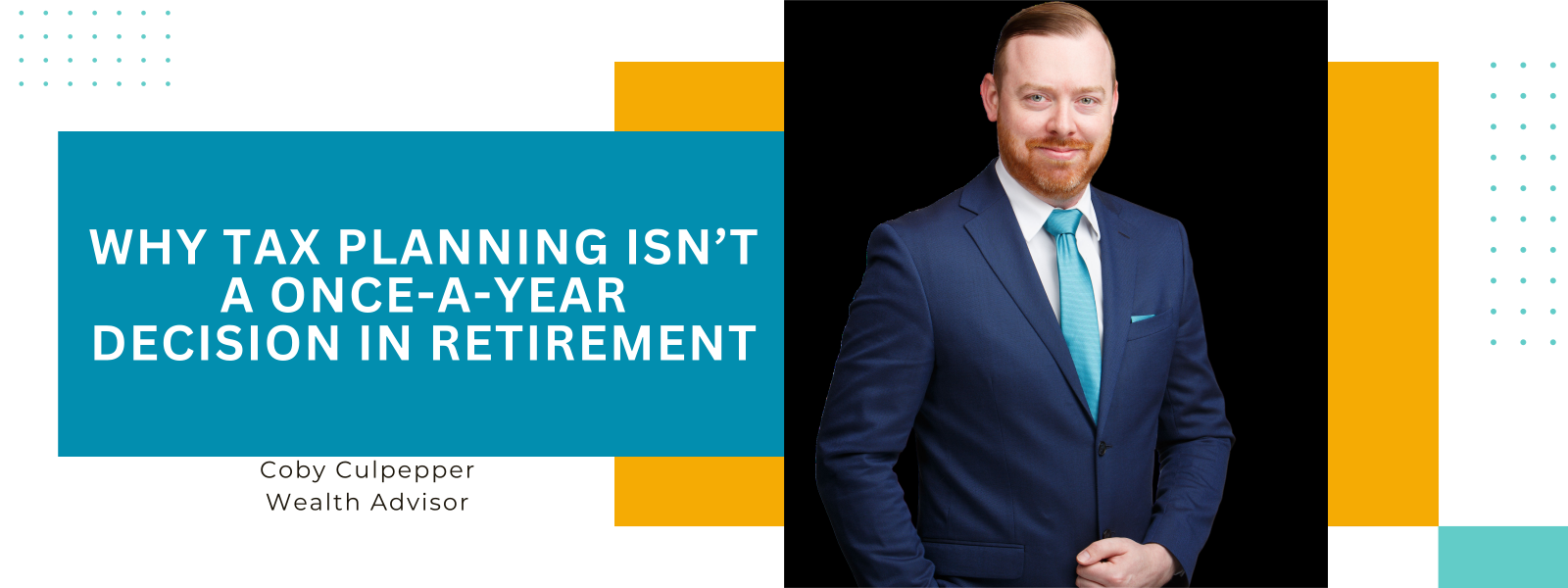
But in retirement planning, taxes are not a single annual event.They are continuous variables that influence income, cash flow, investment decisions, Medicare premiums, and long-term financial security.
If you are within 5–10 years of retirement — or already retired — tax planning is no longer about compliance.
It’s about coordination. Coordination does not occur once a year.
Social Security is far more complex than most people assume. With over 2,700 rules (and thousands of additional interpretations), it’s no surprise that hidden benefits and missed opportunities are common.
If you’re nearing retirement or already collecting, understanding where these opportunities exist can help you gain more income over your lifetime — sometimes significantly more.

Taxes Touch Every Retirement Decision
In your working years, taxes are relatively straightforward:
You earn income.
Taxes are withheld.
You file.
In retirement, income becomes layered and flexible — which makes tax planning more complex and more strategic.
Your lifetime tax exposure is shaped by:
- How your retirement accounts are structured
- When you begin withdrawing income
- Which accounts you withdraw from first
- Required Minimum Distributions (RMDs)
- Social Security timing
- Medicare IRMAA thresholds
- Roth conversion decisions
- Charitable planning strategies
Each decision affects the others. Without coordination, taxes can quietly erode retirement income year after year.

The Shift From Accumulation to Distribution
During accumulation, the focus is growth.
During retirement, the focus shifts to:
-
Sustainable income
-
Withdrawal sequencing
-
Tax efficiency
-
Flexibility
-
This is where many retirees encounter surprises.
For example:
A retiree may believe their tax rate will automatically drop after they stop working.
But once RMDs begin at age 73, mandatory withdrawals from tax-deferred accounts can push taxable income higher than expected.
That can:
-
Increase marginal tax brackets
-
Trigger higher Medicare premiums
-
Cause more Social Security benefits to become taxable
-
The tax return reflects these outcomes.
But the strategy that led to them may have started 10 or 15 years earlier.
Why Timing Matters More Than Ever
Tax laws evolve.
Contribution limits change.
Bracket structures shift.
The current tax environment reflects temporary policies that may not remain permanent. For many households, future marginal rates may be higher than today.
That makes timing decisions more critical.
Strategic tax planning considers:
- When to recognize income
- When to defer income
- When to convert to Roth
- When to accelerate deductions
- When to delay Social Security
These are not once-a-year decisions.
They are ongoing calibration decisions.
For many pre-retirees, the years between retirement and RMD age represent a valuable planning window.
Once RMDs begin, flexibility declines. That is why proactive planning matters — not reactive filing.
The Hidden Impact of RMDs
Required Minimum Distributions are often misunderstood.
At age 73, the IRS requires withdrawals from traditional IRAs and 401(k)s — whether you need the income or not.
Those withdrawals:
- Increase taxable income
- Can push you into higher brackets
- May increase Medicare IRMAA premiums
- May increase Social Security taxation
And because RMDs are calculated as a percentage of account balances, large tax-deferred accounts create larger forced withdrawals.
The tax impact compounds.
Many retirees do not realize:
RMD exposure is built during accumulation years. Without earlier tax diversification — taxable, tax-deferred, and tax-free — flexibility later becomes limited.
Tax planning isn’t annual because RMD exposure isn’t annual.
It is structural.
Ask yourself:
- Do I know how large my RMDs are projected to be at age 73?
- Have I modeled how those withdrawals affect Medicare premiums?
- Do I have tax-free income sources available?
- Have I evaluated partial Roth conversions before RMDs begin?
If these questions are unclear, that’s exactly what we review during our 15-Minute Tax Diversification Strategy Check-In.
It’s a focused conversation to determine whether your current structure supports long-term flexibility — or creates future tax concentration.
👉 Schedule a complimentary check-in and evaluate your exposure before it becomes permanent.
The Medicare IRMAA Factor
One of the most overlooked elements of retirement tax planning is Medicare IRMAA (Income-Related Monthly Adjustment Amount).
Medicare premiums increase once income crosses certain thresholds.
Those increases:
- Apply to Part B and Part D
- Can add thousands in annual costs
- Are based on prior-year income
A Roth conversion, large capital gain, or unplanned withdrawal can unintentionally push income above a threshold.
Without ongoing tax planning, these surprises feel arbitrary. With planning, they become manageable.
Managing income thresholds is not about avoiding taxes entirely.
It’s about smoothing income strategically.
That cannot be done once a year.
Social Security and Tax Coordination
Up to 85% of Social Security benefits can become taxable — depending on total income.
What increases total income?
- IRA withdrawals
- RMDs
- Roth conversions
- Capital gains
- Pension income
The interaction is complex.
Without coordination, a retiree may unknowingly:
- Increase taxable Social Security
- Increase Medicare premiums
- Push themselves into a higher bracket
Tax filing reports this.
Tax planning anticipates it.
Planning Creates Options
The primary objective of ongoing tax planning is optionality.
Optionality means:
- Choosing when to take income
- Choosing which accounts to draw from
- Choosing when to convert to Roth
- Choosing when to recognize gains
Without planning, choices narrow.
With planning, flexibility expands.
Ongoing retirement tax planning can help:
- Balance taxable, tax-deferred, and tax-free income
- Reduce long-term RMD impact
- Strategically manage Roth conversions
- Avoid unnecessary Medicare premium increases
- Adjust to legislative changes
- Coordinate withdrawals for lifetime efficiency
A tax return looks backward. A tax strategy looks forward.
The Cost of Viewing Taxes as Annual
When tax planning is treated as a once-a-year exercise, common outcomes include:
- Overconcentration in tax-deferred accounts
- Missed Roth conversion windows
- Reactive RMD management
- Unanticipated Medicare premium increases
- Higher-than-necessary lifetime tax payments
These are not catastrophic errors.
They are gradual inefficiencies.
And gradual inefficiencies compound.
Retirement may last 25–30 years.
Even small annual tax inefficiencies can create six-figure differences over time.
What Ongoing Tax Planning Actually Looks Like
Ongoing tax planning does not mean constant transactions.
It means annual review within a multi-year framework.
It typically includes:
- Reviewing projected tax brackets
- Evaluating Roth conversion thresholds
- Monitoring RMD projections
- Reviewing withdrawal sequencing
- Monitoring Medicare IRMAA brackets
- Coordinating charitable strategies
- Adjusting based on life changes
It is deliberate.
Measured.
Coordinated.
Not reactive.
For many retirees, the biggest shift is mindset. Taxes are no longer something to minimize this year.
They are something to manage across decades. The objective is not the lowest tax bill this year.
It is the lowest reasonable lifetime tax burden — while maintaining flexibility.
That requires ongoing review. Not just filing.