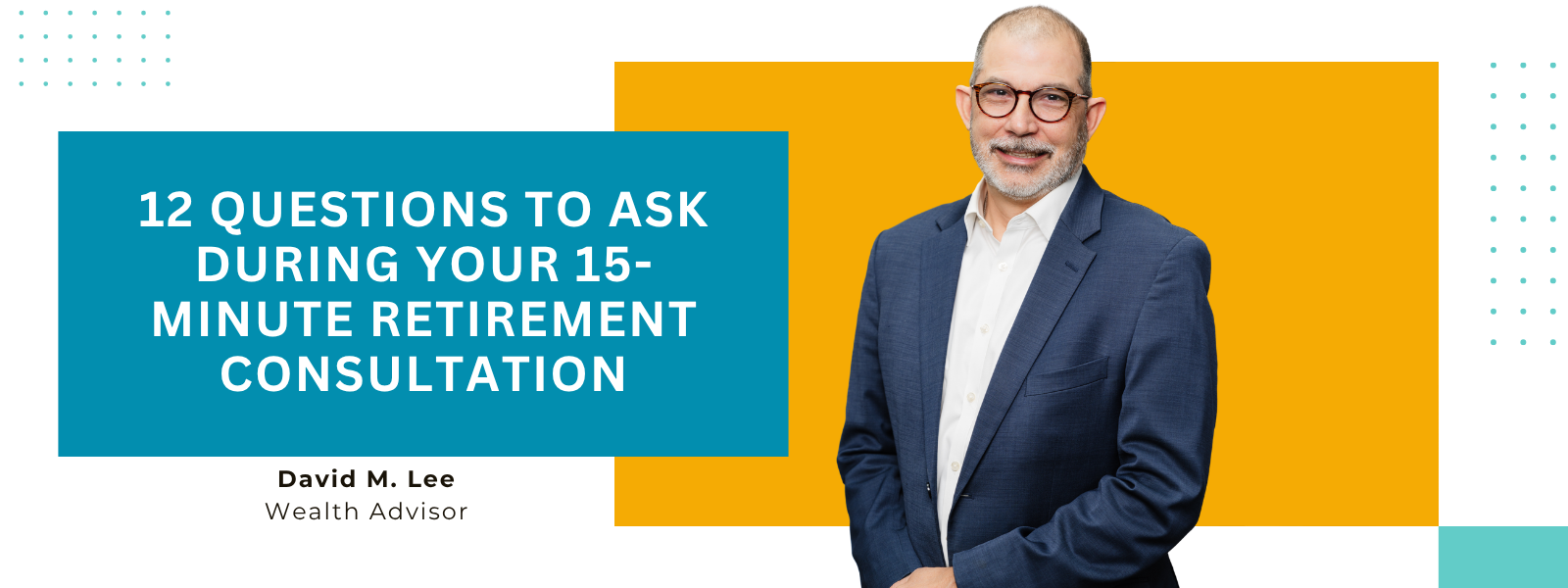
12 Questions to Ask During Your 15-Minute Retirement Consultation
By David Lee, Wealth Advisor · October 30, 2026 · 6 min read · Impact! Partners Financial · Houston, TX
The Short Answer
A 15-minute retirement consultation is a short, no-pressure conversation to see whether an advisor understands your situation and is a good fit. The most useful questions focus on how the advisor is paid, whether they’re held to a fiduciary standard, what a full plan includes, and what the next step would look like.
Fifteen minutes goes fast. Most people spend the first ten explaining their situation and the last five wondering what they should have asked.
That’s a missed opportunity, because a short consultation is one of the few low-stakes moments where you get to interview an advisor before you share account statements or commit to anything.
I’ve sat on the advisor side of a lot of these conversations. The people who get the most out of them come with a few questions written down. This article gives you those questions, explains why each one matters, and tells you what a good answer sounds like.
Set Expectations
What a 15-Minute Consultation Is (and Isn’t)
At Impact! Partners Financial we call our 15-minute consultation a Check-Up. It’s a chance to talk about where you are, what’s on your mind, and whether a deeper planning meeting would be worth your time.
What It Isn’tNot a screening call, not a sales script, and not a full financial plan. Nobody can responsibly tell you how much to withdraw, which accounts to convert, or when to claim Social Security in fifteen minutes.
What It IsA chance to learn how the advisor thinks, how they’re paid, and whether they’re asking the right questions about you.
A Useful Rule of ThumbUse the fifteen minutes to interview the advisor — not to get a full plan.
Questions 1–4
Questions About the Advisor
1
Are you held to a fiduciary standard, and when does it apply?An Investment Adviser Representative is held to a fiduciary standard when giving investment advice and is legally required to act in your best interest. Many professionals also offer insurance or other products, which may be governed by a different standard. Ask which standard applies to each type of recommendation they might make, and where that is described in writing.
2
How are you paid?This is the single most important question, and a trustworthy advisor will answer it plainly. How someone is paid can shape what they recommend — see the three common models below.
3
Can I see your Form CRS and ADV Part 2?Registered investment advisers must provide a Client Relationship Summary (Form CRS) and a brochure (Form ADV Part 2) describing services, fees, and conflicts of interest. You can also look up an advisor on the SEC’s Investment Adviser Public Disclosure site at adviserinfo.sec.gov. An advisor who hesitates to share these documents is telling you something.
4
Who do you typically work with?An advisor who mostly works with young professionals building wealth may not be the right fit for someone five years from retirement. Ask about the stage of life, income sources, and concerns of the people they usually help. In the Houston area, many pre-retirees have energy-sector pensions, company stock, or deferred compensation — experience with those is worth asking about.
Three Common Ways Advisors Are Paid
Advisory FeesA percentage of assets managed, a flat fee, or an hourly or project fee.
CommissionsPaid by a product provider, such as an insurance company, when you buy a product.
Fee-BasedA combination of advisory fees and commissions.
None of these models is automatically good or bad. What matters is that you understand them. Ask: “If I became a client, what would I pay you, and would you earn anything else from products you recommend?”
Questions 5–7
Questions About Your Situation
5
Based on what I’ve shared, what would you want to look at first?This shows you how the advisor prioritizes. A thoughtful answer will usually point to something specific: your income gap in retirement, the tax mix of your accounts, your Social Security timing, or how much of your savings is exposed to market risk in the first years of retirement.
6
What information would you need to give me a real answer?Good advisors are comfortable saying, “I can’t answer that yet.” The follow-up should be a clear list: recent statements, pension estimates, Social Security statements from ssa.gov, a tax return, and your expected expenses.
7
What do people in my situation most often overlook?You’ll learn a lot from the answer, and you might hear something you hadn’t considered — such as how required minimum distributions can push income higher later in retirement, or how a surviving spouse’s income changes when one Social Security check stops.
Questions 8–12
Questions About the Process
8
What does a full plan include?Ask what you’d actually receive. A comprehensive retirement plan usually addresses income, investments, taxes, Social Security, health care costs, risk management, and legacy wishes. Ask whether the plan is written, how often it’s reviewed, and whether it changes as your life does.
9
How often would we meet, and who would I talk to?Some firms assign one advisor; others use a team. Neither is wrong, but you should know who answers the phone when markets drop or when you have a question about a distribution.
10
How do you approach risk as I get close to retirement?Listen for an answer that connects investments to your income needs instead of just naming a portfolio. The early years of retirement carry sequence-of-returns risk: a market decline right when withdrawals begin can have a lasting effect. Ask how the advisor plans for that.
11
Do you coordinate with my CPA or estate attorney?Retirement decisions overlap with tax and legal matters. Many advisors don’t give tax or legal advice themselves, but a good one will work alongside your professionals rather than around them.
12
What’s the next step, and is there any obligation?A clear answer protects you. You should know exactly what a second meeting involves, how long it takes, what it costs (if anything), and that you’re free to walk away.
Cheat Sheet
The Five Questions That Matter Most
QuestionWhy It Matters
How are you paid?Compensation can shape recommendations
Which standard applies to your advice?Standards can change by product
What would you look at first?Shows how they prioritize
What would you need from me?Shows they won’t guess
What’s the next step?Confirms there’s no pressure
Before You Call
How to Prepare in Five Minutes
You don’t need to bring documents to a 15-minute consultation, but a little preparation helps you use the time well.
Have These Ready
✓ Your approximate retirement date, or the range you’re considering✓ Your account types: 401(k), IRA, Roth, pension, brokerage, cash✓ The one question that keeps you up at night✓ Your spouse, if you’re married — retirement decisions affect you both
Warning Signs
Red Flags to Listen For
Most advisors are honest professionals, but a short consultation is also a chance to notice warning signs. Be cautious if an advisor:
✗Recommends a specific product before learning about your situation
✗Avoids a direct answer about compensation
✗Pressures you to decide quickly
✗Promises a particular return
Retirement planning is a long relationship. The first conversation should feel like the start of one.
FAQ
Frequently Asked Questions
Is a 15-minute consultation with a financial advisor free?
Many firms, including Impact! Partners Financial, offer a short introductory consultation at no cost and with no obligation. Always confirm before you book.
What should I bring to a first meeting with a financial advisor?
For a 15-minute consultation, you usually don’t need documents. Bring your approximate retirement timeline, a list of your account types, and your top questions. A deeper planning meeting will typically call for statements, pension estimates, and a recent tax return.
How do I know if a financial advisor is held to a fiduciary standard?
Ask directly which standard applies to each type of recommendation. You can also review the advisor’s Form CRS and Form ADV Part 2 and search the SEC’s Investment Adviser Public Disclosure website.
Can I get real retirement advice in 15 minutes?
You can get clarity on your biggest questions and a sense of whether the advisor is a good fit. Specific recommendations require a full review of your income, assets, taxes, and goals.
Key Takeaways
A 15-minute consultation is a chance to interview the advisor, not to receive a full plan.
Ask how they’re paid, which standard of care applies to their recommendations, and what the next step involves.
Come with your timeline, account types, and your biggest question.
Have questions about how this applies to you?Book a 15-minute Check-Up with Coby. It’s not a screening call and not a sales script — it’s a short conversation about where you are today and whether a deeper planning meeting makes sense.
The commentary on this blog reflects the personal opinions, viewpoints and analyses of the author, and should not be regarded as a description of advisory services provided by Foundations Investment Advisors, LLC (“Foundations”), or performance returns of any Foundations client. The views reflected in the commentary are subject to change at any time without notice. Any mention of a particular security and related performance data is not a recommendation to buy or sell that security, or any security. Foundations manages its clients’ accounts using a variety of investment techniques and strategies, which are not necessarily discussed in the commentary. Foundations deems reliable any statistical data or information obtained from or prepared by third party sources that is included in any commentary, but in no way guarantees its accuracy or completeness.
This is not endorsed or affiliated with the Social Security Administration or any U.S. government agency.
A Roth conversion may not be suitable for your situation. The primary goal in converting retirement assets into a Roth IRA is to reduce the future tax liability on the distributions you take in retirement, or on the distributions of your beneficiaries. The information provided is to help you determine whether or not a Roth IRA conversion may be appropriate for your particular circumstances. Please review your retirement savings, tax, and legacy planning strategies with your legal/tax advisor to be sure a Roth IRA conversion fits into your planning strategies.
Comments regarding safe and secure investments and/or guaranteed income streams refer only to fixed insurance products and not any investment advisory products. Rates and guarantees provided by insurance products and annuities are subject to the financial strength of the issuing insurance company; not guaranteed by any bank or the FDIC.
Written By: David M. Lee
David Lee is a Wealth Advisor at Impact! Partners Financial, where he specializes in helping pre-retirees and retirees build comprehensive retirement strategies designed to support long-term financial confidence. Through a disciplined, plan-driven approach, David helps clients navigate retirement income planning, investments, and key financial decisions with clarity and purpose. Known for his empathetic and client-centered style, he is committed to building trusted relationships and delivering guidance that allows clients to enjoy retirement with greater peace of mind.